

BARDO NOIR
Enter my creative process. ✦✧

There is something alluring about following Thomas Pynchon’s example and withdrawing from the world, only to resurface now and then with a finished novel, as if from nowhere. But we are who we are, and for me writing has always begun on the internet, stretching from football to reviews to poetry* and fiction. Publishing a novel in print was a big moment, as was writing a short story for radio, but to me those things are the equivalent of a rock band playing an arena show.
Naturally, it was exhilarating and unforgettable. Yet the real act of creation takes place elsewhere. It happens here, week after week. Unlike Pynchon and his kind, I have never minded sharing work in progress. If anything, it is readers’ expectations and involvement that sharpen the text and make it better. Less Pynchon. Very internet.
After some time experimenting with this platform I have found a formula that seems to work for me: to keep the shorter pieces freely available to everyone, and to place the longer ones (such as Zenopolis, Naïveté Travels, and others) behind a paywall, as a kind of filter, allowing me to continue publishing semi-openly without burning bridges. It also makes it a little easier to use my full range, knowing I am doing so before a smaller group of benevolent like-minded readers.
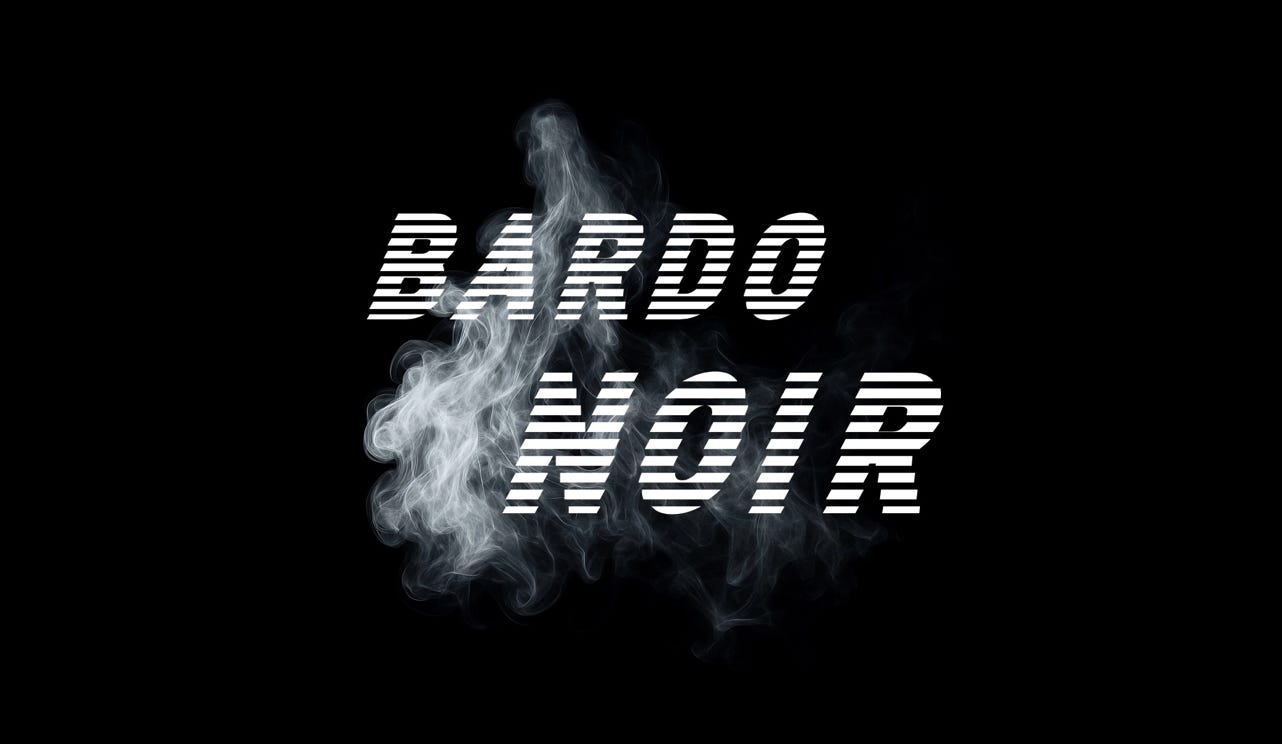
This post contains the first chapter of my still only just begun story BARDO NOIR, a piece influenced by films like The Third Man and Casablanca, the TV series Ripley, and the computer game Grim Fandango. Black and white, smoke and mirrors, adventures waiting around every corner.
If you would like to read the next chapter, which is published on a separate Substack, you will need to become a paying subscriber to The Bagatelles. Otherwise, this chapter also stands on its own, as a bagatelle.
Welcome away ꩜
* Salka.se was a writers’ community I started with a friend in 2003. A bit like Substack, only without the newsletters. Not a small only, though.

✦ BARDO NOIR: The Beginning ✧
I have sinned, and it feels so desperately good to admit it, to once and for all come out as who I am, not who I appear to be.
It is no small sin either.
But let’s not talk about that now. I just needed to get it out of the way, as background information for why I sold everything. I arranged a yard sale and let go of the amplifier, the freezer, the broom, the heirlooms and the childhood memories. The neighbours were a little bewildered at first, since they weren’t used to such situations, as we had otherwise competed quietly to own the most, and now they could snatch up all my expensively acquired material status. When they realised I’d gone mad they swarmed like vultures over everything, especially when they discovered they could bargain as low as they wished without me refusing. Had they asked for free I would have said free. Then I rented a container, heaved in what remained, and even those things drew the neighbourhood’s treasure hunters at night, so in the end there was just one final trip to the dump before I was emptied. At the viewing the house was a shell, every mark on the wall visible, every water stain on the parquet. I had to accept a shamefully low offer, but after that I was at least empty, light and free. I left the car in the airport car park, with the key inside.
The customs officer grew suspicious of me. I had arrived in Kathmandu in the middle of the night on a sparsely filled flight. The other passengers were seasonal labourers from Qatar who looked as though they had been working for half a year straight, and probably had. It wasn’t my fair skin that made me stand out, but my lack of luggage. Not even a cloth bag. Not even a toothbrush. The officer asked me to come with him, and I was led to a windowless room with metal walls. “So, what’s this about?” he asked indifferently, stifling a yawn. “Nothing in particular,” I said. He continued: “You know we mostly deal with backpackers from your country? The odd hippie too, and then the junkies, those who arrive empty-handed but try to leave bursting.” He tapped his fingertip against the table, as if sketching a mind map and adding the decisive arrow. “So which category do you belong to, sir?”
That was when I had to explain in what way I had sinned. He listened with increasingly glazed eyes, and when I had nothing more to say he concluded grimly: “That was no small sin either.” The interrogation had gone on for several hours already, dawn had almost turned to morning, and I think his shift was nearly over, because suddenly he became impatient. He summed up the night’s dilemma with the words: “It’s not illegal, after all, to own nothing.” The room was unlocked and I was released. It would probably have been appropriate to claim that I had a plan, that I would seek out this or that person, sort everything out and build myself a life, but I was hollow inside as well, assuming things would change over time once I changed my surroundings. Then I could become someone else, and as someone else I would not need a plan, because the plan would not be mine. Something like that had gone through my head as I swirled up and down through Himalayan turbulence, to and from K2, more than once thinking that I would be the first to be eaten in the event of a crash.
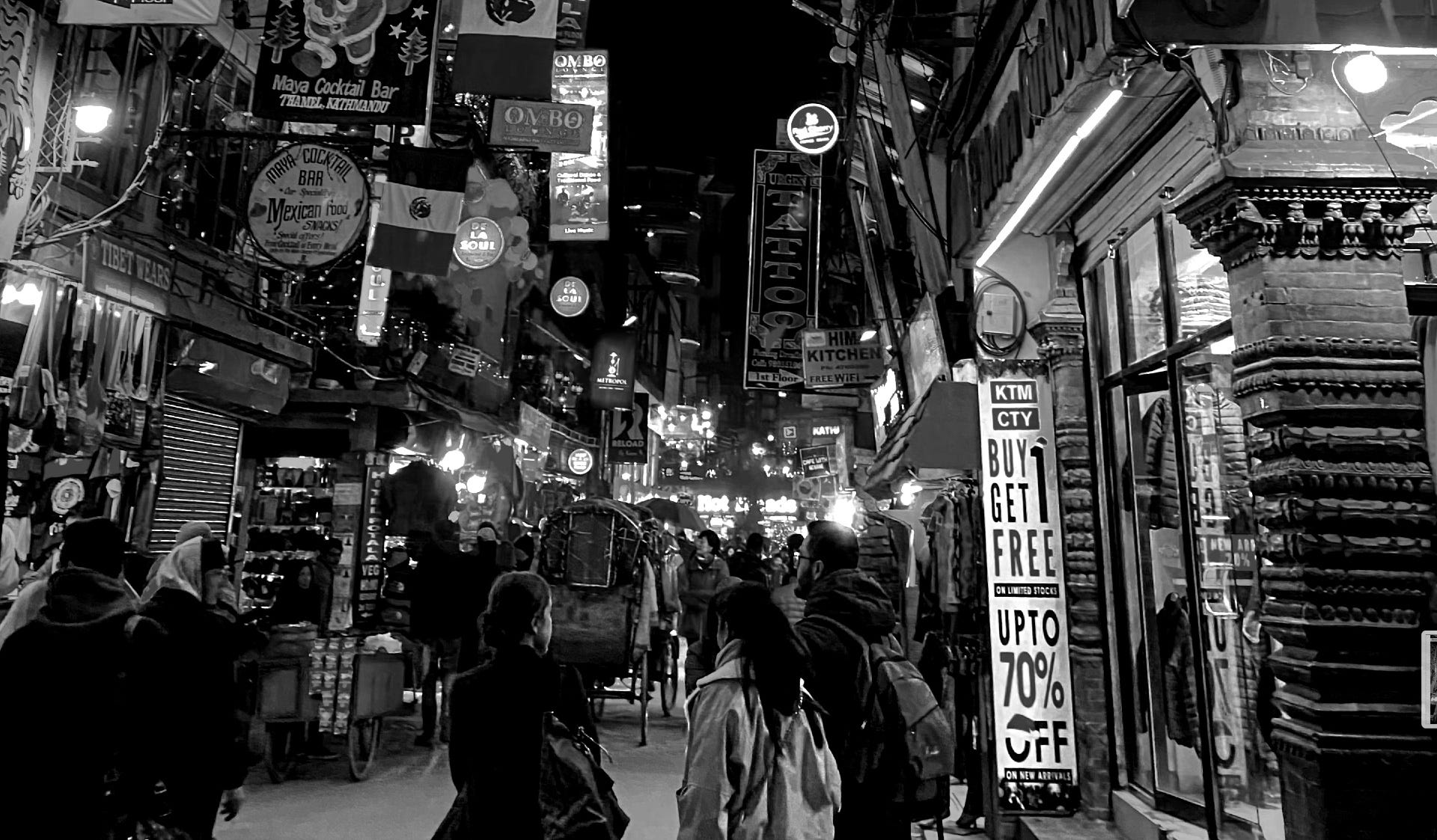
I wandered via Ring Road and Pashupati, Dillibazar and Lainchaur, and at the beginning there were no pavements, but since it was so early the traffic was still sparse and the air not yet filled with smog. Only after an hour or so of walking did lines of cars and scooters start whizzing past just inches away, but I wasn’t especially worried about being run over, because worrying wasn’t my game anymore. From the Pashupatinath temple towards the centre I began to look less of an odd bird. Business had picked up in the shops, traffic lights flickered irrationally, the scent of incense mixed with diesel and cardamom. Stray dogs tried to beg from me but they too soon understood I had nothing to offer. At Thamel Chowk I reached a more international area, probably where the backpackers preferred to end up, and I was about to walk on when someone spoke to me. My mother had taught me always to answer when addressed, and I hadn’t yet lost my sense of manners.
It was a bit tiresome to tell every stranger about my shortcomings, even if transparency might have been the honest thing, so I refrained this time, also because this Australian seemed rather talkative. He was chewing on a juicy chicken wing that he waved in the air like a confused conductor, and when he saw that I was staring more at what he held than at him, he offered me the other wing. “Hungry, eh?” he said as he watched me devour the meat. “Know your type. Takes one to know one. Felt exactly like that myself nine months ago.” I nodded and smiled, grease smeared across my cheeks. “Can I buy you a beer?” he asked, hoping to convert me to an extrovert. I had in fact intended to give away all my money, but I hadn’t decided for what purpose, so I postponed the decision, thinking I might meet someone along the way who needed it more than the Red Cross HR department. A struggling farmer with nine children, I had thought, prejudicedly. A version of the noble savage, perhaps. But that was how I imagined it, that the people here didn’t think much about how they lived, because they were too busy simply living.
There was money enough for many thousands of bottles of Gorkha, but I let him buy me one anyway, for he didn’t need to know that, it would change the mood too much. The whole experience of seeing himself in me would vanish, and I had no one else to turn to in this city. It felt like a positive sensation, I concluded. To need someone, because it implied a future where someone was needed, one in which I was included. We sat down at the corner bar, and he talked on about women (many) and the price of Ethereum (the sky was the limit), without caring that I offered only monosyllabic answers, which was probably why he jumped when I suddenly exclaimed: “Now I know who you look like.” “Oh yeah? Who?” “David Foster Wallace, the writer,” I said. “Almost exactly.”
But he had no idea who that was, even though he’d nailed the look perfectly: the bandana, the glasses, the stubble, the greasy hair, and the torrent of words. Perhaps it was a fashion I didn’t know about, like most fashions really. When I explained how the author had described Roger Federer’s tennis game, he became a little more interested, since I’d touched on sport, though unfortunately not hurling. He was on the board of the Queensland federation, ran the meetings remotely, as the distances were so vast down there it could just as well be done from Nepal.
Only after an hour did he tire of talking about himself. “What about you?” he mumbled. “What do you do all day?” “I work in aid,” I said. It was a lie, absolutely and unconditionally, but it didn’t feel like one. Deceptive only in that he took it to mean I represented some charity organisation, but not in that I intended to practise charity, so that would have to do. “No offence,” he said, “but you look like you could use some aid yourself, mate.” I turned towards the window and saw a translucent mess of my reflection stare back, and yes, indeed, he was right. “A shower would be nice,” I said. “Low expectations, that’s what we like,” he said.
More people began to arrive. They appeared as if from nowhere, since I had kept an eye on the entrance and no one had gone in or out. Only when the fifth apparition turned up did I realise they had all entered through a secret door, hidden behind the totem pole by the bar to provide an easier passage from the neighbouring collective, where people stayed anywhere from a night to several decades, depending on need and convenience. They probably had their breakfast and other meals here as well, I concluded from how easily they moved about the place. The newcomers gathered in small groups along the walls. A scruffy man who looked as though he had once had a wife sat down beside us without saying a word. Visually speaking, he seemed to belong to the place more than the rest of us, could almost have been Nepalese.
The Australian tried to draw him into the conversation. “Naipul, we’ve got a visitor from the land of the living.” But the newcomer said nothing. “What did you mean by that?” I asked. The Australian began talking about the phenomenon of bardo, which I wasn’t familiar with but which the Tibetans apparently believed in. It concerned the intermediate world the deceased wanders through before they can truly disappear. A forty-nine-day journey towards peace. “What are you insinuating?” I asked, but was interrupted by our tablemate, who until now had been silent, suddenly releasing with unexpected enthusiasm what he had apparently been brooding over all this time. He stared deep into my eyes and asked: “Do you think I should buy a stuffed lion?”
What followed was an anecdote about how, as a child in the West Indies, he had been fascinated by the busts and animals his English teacher decorated his colonial villa with, and which he later came to associate with success, without thinking much of it until he realised that the natural history museum was currently clearing out, having had to downsize after the earthquake. A stuffed lion was up for auction. Unfortunately a female, but a lion nonetheless. “Yes, if you’ve waited that long, I think you should buy it,” I said. “Are you mad? It costs two months’ salary!” he exclaimed, as if questioning how I could be so reckless with money as to consider such a risky investment.
When I went to find the toilet the Australian followed to explain. He dried his hands with paper towels and said: “Sorry, mate, bit of an odd character, that one. We don’t even know his name. So we call him Naipul, after the only celebrity from his homeland. Kind of like how people call me Croc. You’ll have to be Björn, I guess.” Only in the fluorescent light did I notice that his pupils were wide open, as if he were staring into the sun. “I was just about to leave anyway,” I mumbled. “Shame, I actually needed your help with something,” he said, suddenly sober. I almost expected a business card and a pitch, but he only patted me on the shoulder, as if no words were needed, since we understood each other so well, as if we’d played this scene before and never forgot our lines. “We’ll sort it next time, Björn,” he said, and winked. It took several seconds for the wrinkle around his eye to ease.
Note: Parts of the opening sentences are borrowed from an essay by Eric Schüldt. He has approved my use of them.
If you want to read the next chapter, and the still unwritten, you have to be a paid subscriber to The Bagatelles.
Thank you for reading.
– Jörgen Löwenfeldt ✦ jorgenlowenfeldt.se
This dispatch went out to 1,230 readers across 69 countries. If it resonated with you, consider sharing it with a friend who might feel the same, leaving a comment, or recommending it on your own Substack.
A warm thank you to the 14 sponsors of The Bagatelles. Your belief in my work keeps me going, and as a paid subscriber you have access to all long-form content, including the novel Zenopolis, all chapters of Naïveté Travels, and my work in progress: Bardo Noir.
Maybe you'd appreciate this:
✦✧ Looking for the archive? You can find every post here.
This post gave me a kind of permission to pursue a larger breadth of writing here - I've got a novel cooking and it's asking to be "seen"
Living in sin--a valid beginning! Just sayin'.