

When the Body Keeps the Code
✦✧ A muscle memory special: door codes, someone from before, and a reunion in a pen shop.

A few years ago, I found my childhood home on Airbnb. I rented three nights in my boyhood bedroom and invited my siblings on the trip back in time. It turned out to be one of the strangest journeys I have ever been on, more mind-expanding than the night bus to Bombay or the desert drive in Jordan.
It was hard, after all, to prepare for the experience, because it was a first, but in an eerily familiar way. The bed stood in the same corner as when I lived there several decades earlier, and on waking, my legs instinctively pulled in, not wanting to knock the speakers over. But there had been no speakers beside the bed for many years. Yet in me, on waking, they were standing there, and I might just as well have been a teenager on his way to school as a father of two on a nostalgia trip. All time was latent in me, ready to be activated. In that very second I was immortal.
(If the story feels familiar, I wrote about it in more depth in my Q&A dispatch).
The body keeps the score, as they say. But it keeps codes, signatures and people too. That is the theme of this dispatch of The Bagatelles. Below, I offer you an essay on door codes (non-fiction), a short piece about the time travel of meeting someone from the past (more fiction) and a bagatelle about a more unusual reunion (all fiction).
And while we are touching on autofiction, do not forget to follow the novel The Last Siamese, which is developing with a new chapter every Sunday. We are already on the third, in which the intern Jörgen Löwenfeldt has found himself in some rather comforting dilemmas. So make sure to come along before the paywall (or wait for it and sponsor my writing). Each dispatch is free for the first two weeks.
Welcome away ꩜
Jörgen Löwenfeldt
Has The Bagatelles become part of your routine?
Join the small inner circle that keeps these letters alive.
It costs $5/month, or $2.50/month if you choose the yearly option.
These are the lowest prices Substack allows.
This is what you get access to in the inner circle:
My newest bagatelles first, shared privately in the readers’ chat (including those in this dispatch).
Access to the readers’ chat, where you can discuss the pieces with me and other readers.
All long-form writing, including my blog from living in Ingmar Bergman’s house, all chapters of Naïveté Travels, the story Paradise City and the short story Atlas. And more.
Three full novels in separate publications: Zenopolis, BARDO NOIR and The Last Siamese. I’ll add you manually.
All bagatelles placed behind the paywall (which I use as a filter, so I don’t have to share everything with the world).
And you’ll be supporting my work, helping me keep sharing my fiction with readers in more than 100 countries

✦ Four Seven One One ✧
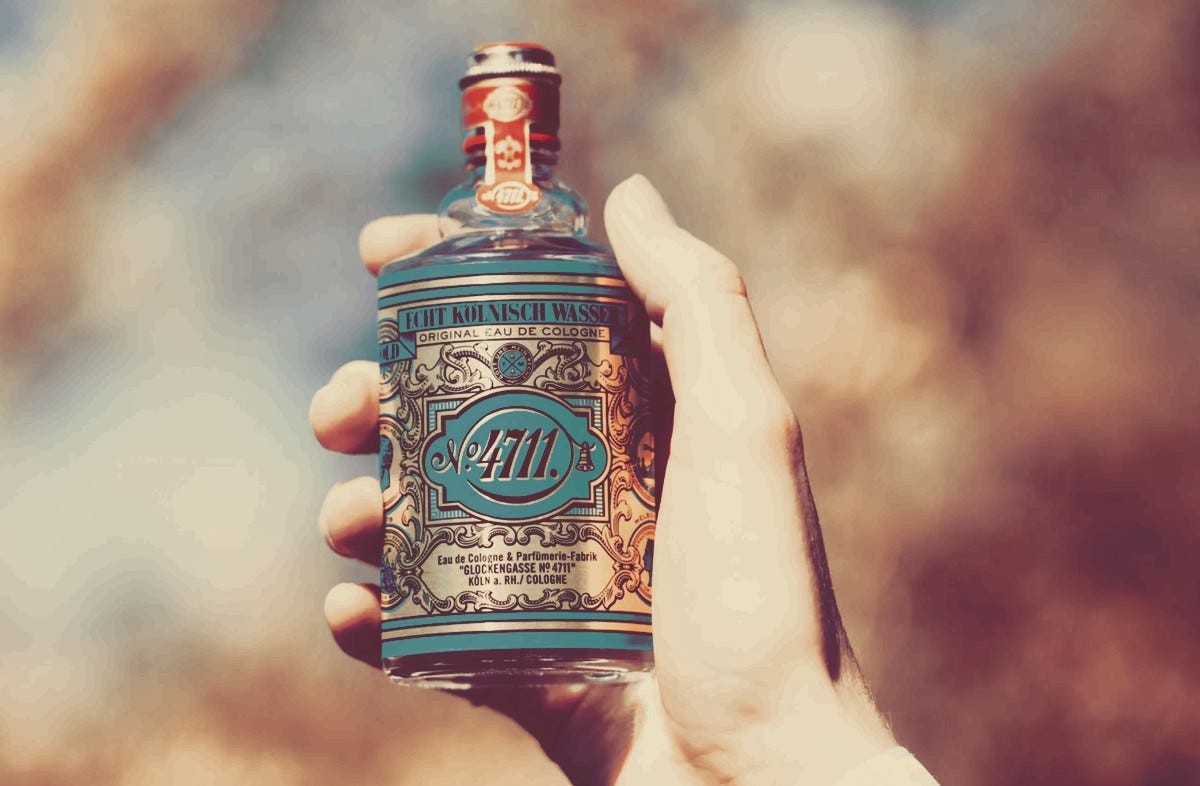
In the good old days it was easy to get in everywhere. All you had to do was read the marks on the keypad and guess the movement. Like at my grandmother and grandfather’s, where the code was 4711, like the perfume, a little left-leaning movement that wore the numbers away on one side. In other words, you could get in on general knowledge alone and a touch of deductive reasoning. Not least since every other entry code carried some memorable story, because whoever had initiated it understood the art form and did not want to squander the act of creation on chance. The residents could therefore parade their interest in history by saying, instead of the actual digits: “the Battle of Lützen”, “Gustav Vasa’s coronation” or “the end of the First World War”.
Surprisingly often, “the Battle of Hastings” also appeared, which is really an irrelevant year for a Swede, but the kind of knowledge drilled into people at school and which landlords and the chairmen of housing associations evidently recited in their sleep. And since one did not necessarily carry an encyclopaedia, the Junior Woodchucks’ Guidebook, or even an almanac of facts in those days before smartphones broke through, one simply had to hope that the worn digits would at least give a hint of the right century.
4711, EdC from Mülhens, is a German eau de Cologne launched in 1792. According to the company’s founding myth, the brew came from a monk’s secret recipe for a miraculous decoction, prepared as a wedding gift for the merchant Wilhelm Mülhens. True to his profession, he sniffed out a good business, and of course a story that would sell. The name 4711, printed in large figures on the bottle of Kölnisch Wasser, derived, suitably for this essay, from the house at Glockengasse 12 in Cologne to which Wilhelm moved in the middle of the nineteenth century. It had the house number 4711, which was listed beside the founder’s name in the local address book, precisely as an alias: and voilà, the conditions were suddenly in place, long before the entry code had even been invented.
I had to look all this up, because although I had keyed in four seven one one thousands of times as a child, a young person and an adult, my research never went further than settling for the explanation: it is a classic perfume. Had you asked me to name another one, I would have had no idea. And the supplementary fact: it is one of the most common entry codes, so if you are locked out somewhere, try it. But despite this well-meaning tip, those numbers never worked anywhere else. So it cannot have been entirely generic. A shame all the same, since, like every popular four-digit code, it has the advantage of being rhythmically right, like a little finger dance across the keypad, and like every dance it is important that it be performed without stumbling, and naturally without having to cross your fingers, or by resting your palm against the box and using your thumb as well, which is against the law. Here the index finger is king. Besides, these are numbers the inhabitants of the building will have to live with for a long time, a practical and elegant little everyday choreography. Preferably one to speak of, discreetly, aloud.
That was also the case for my grandmother and grandfather, who for many decades lived with and as 4711. It was probably the only code they had ever lived with. Not that the locked entrance itself really mattered very much, because there were not many strangers running around the neighbourhood anyway, meaning that loose dangerous sort of people whom the whole procedure of a locked entrance was meant to keep out. And besides, the newspaper delivery person needed it, as did the postman, the people delivering advertising leaflets, various tradesmen, and all the relatives, not least the grandchildren, so they could drop by whenever they liked, and everyone who at some point in the last thirty years had been to a party in the building and had at some point been rather politely informed by the host and hostess, over the home telephone, that the number combination was very easy to remember. Like the perfume, that’s all. Oh, right, of course, everyone would then respond, and perhaps one felt a little stupid, or a little clever, as I did myself now when I learnt the background story, which I would gladly have held forth on if anyone had had reason to listen to the anecdote about the monk.
Unfortunately, there are probably not many people interested in knowing more about an eau de Cologne from 1792, since the code was changed from one day to the next. It happened quite suddenly, in connection with the entire locking device being replaced. It was presumably something that, like everything else these days, was simply done rather quickly, without consulting anyone, and this person, who was probably a man, keyed in four digits and then everyone had to learn to identify themselves with them. 2525. Two five two five. Unimaginative. A terrible code, unless it belongs to the child’s first tablet.
These numbers, even though they are closer in time to the moment of writing, I have never memorised. Instead they are stored in one of my phone’s many notes, the one named “entry codes”, where I have written them down as soon as I have been given them. In theory, that means I only need to ask once. Alongside a long row of names of people I no longer see, workplaces that are not mine, there is also the toilet code for the café on Götgatan. They change often. There is someone called “the psychologist”, though I no longer remember which one, and the allotment area by Vitabergsparken, which I was given access to one stressful spring, but never used for cultivation, and which I now associate only with chaos. These days I do not use the list very often. Except every time I go to another relative’s place, since my general knowledge has not managed to hook that year onto anything. When I search online, I see that it is connected to the French Revolution, riots among students in Scania and the Jewish court jeweller Michael Benedicks immigrating to Sweden.
Sometimes I walk past an entrance from the past and try not to try, simply letting my fingertips touch those small buttons they have met so many times before, letting muscle memory do the work, and not infrequently the little green light flashes its “Open Sesame” and I am admitted, without having any idea which numbers were needed to perform the magic. But even more often the whole process has been erased by the new age of security thinking and technological progress. The modern stranger is therefore asked, via a small screen with digits, to search for a surname and press a telephone symbol. If the resident then chooses to take the call and then press the number five on the keypad of their mobile phone, I am let in. A digital voice says: “Welcome in”, without my ever having 1) felt welcome in 2) thought about what the voice is saying.
My list of entry codes in my phone remains as a memory bank of thousands, millions of finger dances around Stockholm and Sweden, from a time when it mattered which four digits one wished to be associated with. A time that has not quite passed yet, but will soon be as forgotten as the identity of that solitary Carthusian monk with the recipe. If only he knew what his wedding gift would mean to the people at Grevgatan 70.
✦ Someone From Before ✧
Time has passed. It always has, of course. We have to formulate ourselves anew. The time that has passed is mine. Like everyone, I have a certain amount of time. How much, I do not know. All I know is that I have a certain amount of time. That is why it is hard to know what counts as a considerable stretch of time. Even a few years can be the difference between the beginning and the end. I do not know. That is part of the charm.
So time has passed. I meet someone from before. And this time I understand, for the first time, that before is before, and now is not now but afterwards. That last time and this time are forever inaccessible to one another. Between them: a gap. Three hundred parentheses inside parentheses. Probably more.
The person from before is new now. New in the sense of being someone else, older. Probably every cell has been replaced. You are, of course, you. However you have gone about it, you have been you. As a child you were also you. But with everyone else it is different. Because they can actually be other people now. And this person is, the one through whom you notice that time has passed.
She is not the person you remember. She is also the person you remember. You are not the person she remembers. You are also the person she remembers. Everything you have shared is contained in the memories. But you do not talk much about them. They are kept apart, so as not to be contaminated. You talk about now instead. As if no time had passed at all.
✦ The Pen Shop Reunion ✧
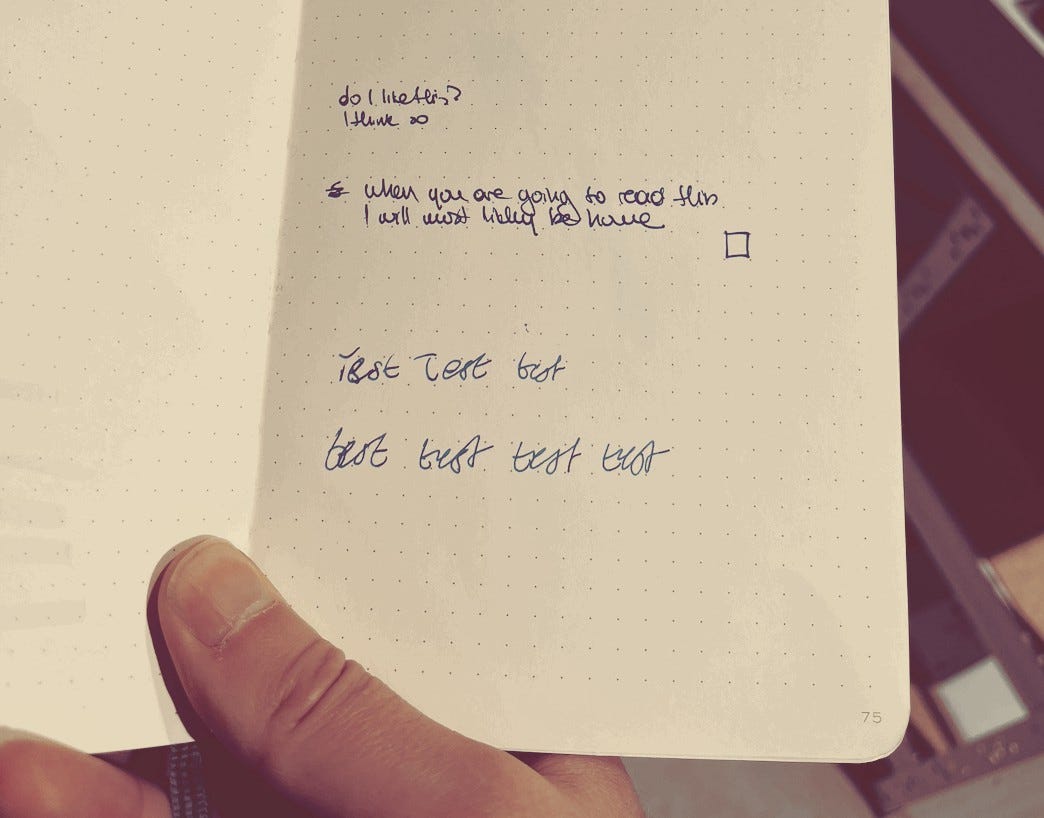
Only those of us with especially unusual names know how it feels when the name appears without warning, as when a mother calls out to her child at a bus stop (once), when an advertising character has been given our name to raise a laugh (also once), or when you, like me, are leafing through the pad in the pen shop, looking for a blank page on which to test the expensive ballpoint, and catch sight of the name amid fictional, delayed dialogues between pen testers of different ages, sticky little figures of doubtful artistic merit and countless variations on the sentence “I’m testing this pen and it seems quite good” in different colours and depths of point.
This unique conversational form of pen shops might possibly have been the subject of a story of its own, were it not for the fact that I stop short, completely as if lightning has split me in two.
Not only am I there once, but a dozen or so times, both in fine ink and black pencil, each time in the same wavily elegant schoolmistress handwriting, which always made her seem a little more well bred than the rest of us. I recognise it the way one remembers a voice or a scent, with such automatic force that I do not even have time to scrabble for the memory, because it is already there, and it is she who has written my name, who has written me, tediously many times, well over a decade after we stopped being meant for forever.
That is probably the rule for all teenage infatuations, really, that one says that, that one believes it, I think, and recall all her curly letters and invitation cards. They had a calligraphic quality. No wonder she has refined that talent by becoming the kind of person who tests expensive pens when most people, like yours truly, make do with whichever one is closest to hand, but now that I am buying a graduation present I thought, avuncularly, that a fountain pen would suit the young man, not because I have ever used one myself, but because it feels right, the sort of thing one buys to encourage an interest, or one that ought to exist. That or coasters from William Morris. Or a bowl from Iittala.
And then I see the name, the name, the name, repeated, the one that basically belongs only to me, which has neither a name day nor Scandinavian frames of reference, the name everyone constantly reacts to with: “Right, could you repeat that?” And I can. “And how is it spelt?” And I spell it out with particular emphasis on the accent and the dissonance. “I’ve never heard that before, actually.” “No, it’s a bit unusual.” “French?” “Romansh. No, we’re not from there. It’s a long story.” Sometimes I have to tell it too, usually in the sharply shortened version, which basically comes down to my epidural-blissed mother seeing a name in the newspaper in the maternity ward and taking it as a sign from the Lord Our Creator. As I say, there is a fuller, considerably sharper version too.
So there I am in the pad, taking up all the space, and now I am the one holding the pen. Without further thought, I draw in a plus sign and then add her name after my own. I do the same on every line. She and he. She and he. Muscle memory senses that we have done this before, though I do not know when or how, but it feels like the most natural thing in the world to join us together before the future spectators in the shop, who, in their search for a blank page, will be made to witness a reunion.
After the misunderstanding, we met only once, very briefly, in the shopping centre outside the shoe shop, when she was there with her mother and smiled awkwardly and said “hello there” (not hello, hello there), then she moved away to study while I stayed at home and avoided student loans. And that was just as well, because that was how I could afford the sailing boat, once upon a time, which became the beginning of everything, the so-called career.
The whole page is now ours, once again as a couple. Unfortunately, I am not entirely happy with the pen, whose nib leans too heavily, and instead choose one already lying in a box. It will probably not be used by the boy anyway, and if it is, only once the ink has dried.
When I am standing at the till and, after flexing my payment card, ask to have my purchase wrapped, I think of her, the girl, now of course the woman, who will come back here and continue testing pens through my name, probably like automatic writing, as unconsciously as some people still use passwords from their teenage years. Then she will see my additions, understand their meaning and think: It is fate.
Then anything can happen.
Thank you for reading.
– Jörgen Löwenfeldt ✦ jorgenlowenfeldt.se
This dispatch went out to readers across 103 countries. If it resonated with you, consider sharing it with a friend who might feel the same, leaving a comment, or recommending it on your own Substack.
A warm thank you to the sponsors of The Bagatelles. Your belief in my work keeps me going, and as a paid subscriber you have access to all long-form content, including the novels Zenopolis, Bardo Noir and The Last Siamese.
Do you have any feedback, ideas, or questions? I answer selected questions in dedicated Q&A dispatches: send them through this form.
You might enjoy this one:
Nobody knows what’s gonna happen at the end of the line, so you might as well enjoy the trip

Memento mori, remember that you must die, the Romans urged, though not to be taken literally. What we are called to reflect on is our mortality, and with it, how we choose to spend our lives.
✦✧ Looking for the archive? You can find every post here.
I remember the homeless would use lighters to burn marks into the correct numbers of different buildings. I always thought that was exciting as a girl, I imagined there were still solidaric vagabonds leaving clues to each other outside of society.
Scents can be so rich with memories! It's always tricky when I revisit places or objects from my early days, especially with someone else. With a sibling it usually turns out fine because we seem mostly aligned about our respective versions of events, but I never go to school reunions because I suspect what I remember happened is quite different from most others.
I also have a special fondness for door codes, even though there’s that slight security risk from guessing numbers based on keypad wear patterns.