

The Wind Chime Chronicles
A story that changes with its surroundings.

Brian Eno once wondered what a piece of music would be like if it worked like a wind chime, adapting itself to its surroundings. That set me thinking along similar lines: what would a wind chime story look like? Because, like him, I am always most interested in: 1) what only I can do, 2) what I have never done before, and 3) preferably what no one has done before.
The multidisciplinary artist Eno has long been interested in regenerative art: the idea of creating a seed, or a strand of musical DNA, then releasing it and seeing what happens. Art that grows1. This approach led, among other things, to the excellent documentary ENO by Gary Hustwit, where every screening appears in a different version using a generative story engine.
This kind of thinking is not entirely new, though. There have been interactive television programmes in the 1990s, including in Sweden and Brazil, where viewers could call in and choose what would happen next. (I once wrote about this concept in a film magazine.) But times have changed, and so have the possibilities. There are probably many ways to create that kind of fleeting story, but today, here on Substack, I thought I would try one specific approach for the first time.
Here is where you come in. You will take the role of the wind in this experiment. I will write a story and give you five possible directions for what happens next. You will have a week to decide, and you are completely free to cheat, campaign, or do whatever you like. Whichever option is leading when the poll closes will become the continuation. Then we will do the same again, with five new alternatives.
The third text will be the ending, chosen from twenty-five possible outcomes2. That is still far fewer than the ENO film’s 52 quintillion potential versions, but after all I am a human being, not a robot. The journey is not guided directly by nature, but it is still shaped by its surroundings. In this case: the readers.
I, the writer, simply adapt.
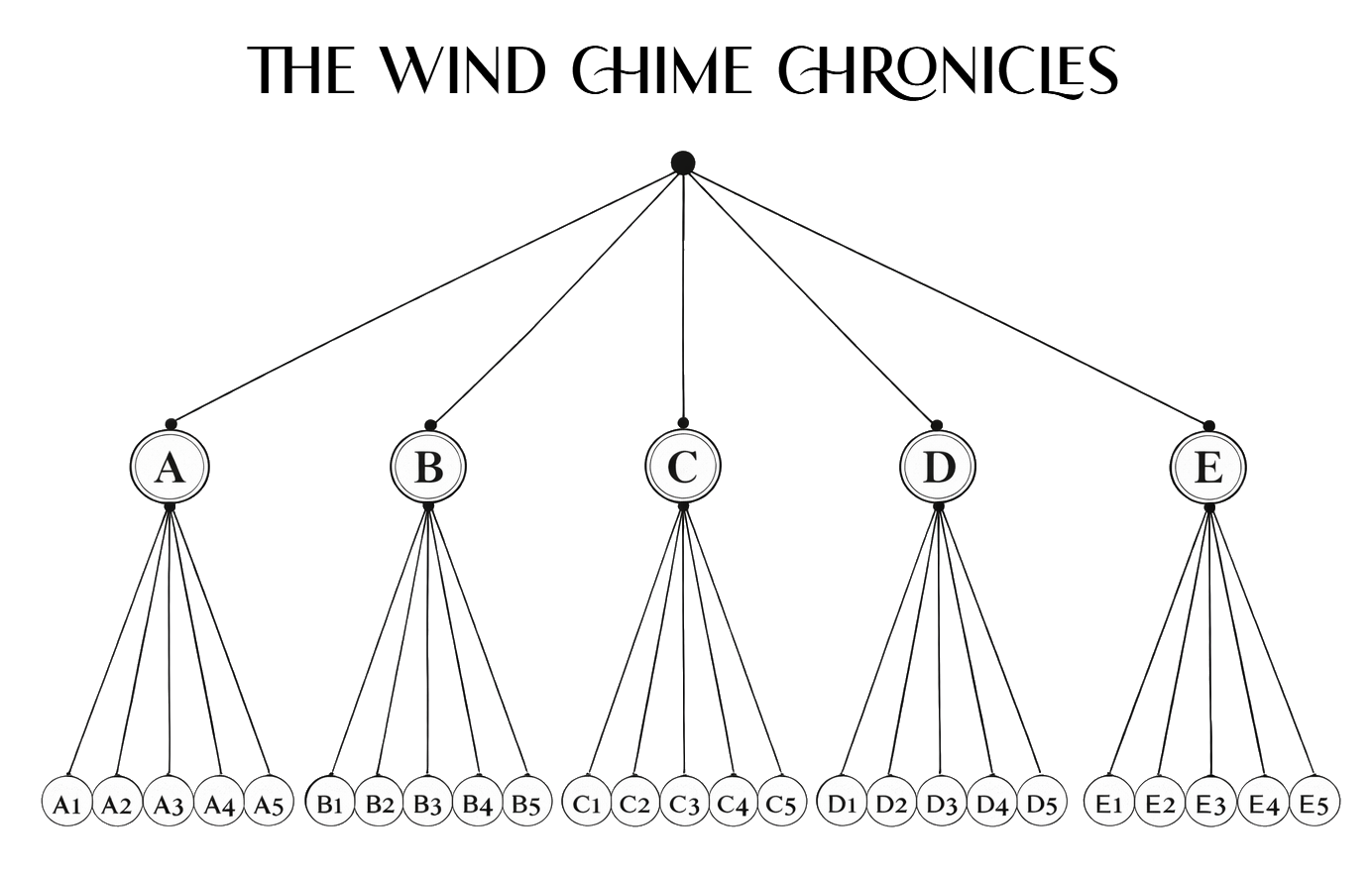
Now you know the rules. Which direction will you choose?
Welcome away ꩜
Jörgen Löwenfeldt
As a paid subscriber you get access to all long-form writing including full novels. It costs $5 a month, or $2.50 a month if you pay for a full year. Substack does not allow prices below that.

presents

The Beginning
We begin high in the sky. It is early morning and the earth has just rotated the sun into view, its rays falling at an angle across the glittering grand apartments along the waterfront and bringing everything to life. But that is not where we are going, nor to the central arteries. Instead we continue moving across the city, still from the bird’s view: the grid of blocks, tangles of tracks and culverts. The traffic has already begun to thicken: lorries, commuter trains, the occasional cabriolet heading south. It is a Monday behaving like one.
Time to choose, to land somewhere, to let the image sharpen. We must stop panning and descend slowly, finding a suburb beyond the old toll gates, with the housing blocks lying like oversized bricks among the pines. Now we approach ground level so that we can see through the windows, almost like doll’s houses. We can take anyone, slip through the half-open blinds, choose a voice and continue to inhabit it. And so it happens.
It becomes you. Perhaps it feels random to be chosen in this way, yet we could have picked anyone. Still, the only outcome we know is yours, so let us assume there is a good reason why we follow you today, and only today and no other day.
You yourself have no time to reflect on such things. Instead you are busy getting ready for your meeting. Normally you would not call yourself vain, but this time you have spent weeks thinking about clothes, shoes, and timing your visit to the hairdresser so that the editor might understand that you are just as interesting in reality as you appear on the screen. In truth you should not be thinking this way. It was she who contacted you, not the other way round. She appeared out of nowhere in your inbox to arrange an appointment. The time has been circled in red in your calendar. You have cancelled things, rearranged things, mentioned it in every conceivable context and said: no, I cannot meet then, because I have a meeting with the publishing house.
You hope she will ask about a novel, even though through your internet alias you have never hinted that you have written one. But you do have one, assembled a decade ago when you were bought out of the taxi company after your investment in a new switching system turned into a fiasco. Customers were connected to other customers. One couple later married, although the management had no use for that knowledge. The union handled the negotiations with the employer and soon twelve months’ salary were transferred to your account in exchange for a promise that you would never again set foot in the office. With the time that money generated you wrote a work about a project manager who was fired from a taxi company. Dig where you stand, Stephen King said, or maybe it was Margaret Atwood.
In any case you are in a rush now, or rather you are hurrying so that it will not turn into a real rush, so you leave home, take the metro, move from the periphery towards the centre, perhaps for the last time as just anyone. Is that why we have chosen you as the protagonist of this story? Are you on your way to becoming someone?
The thing about the address was a little strange, the editor had warned in a follow-up email. On the street there are two buildings with the same number, a heritage-protected mistake that occurred in the eighteenth century and therefore could not be corrected. The confusion deepens because their offices are found on the fifth floor, but only if you take the elevator, whereas if you take the stairs, you will find them on the seventh. In the vestibule it is claimed that the real location is on the sixth floor, but that notice you were asked to ignore, because almost nothing there was correct anyway.
That would surely sort itself out, you had thought when skimming the information, but when you, after zigzagging through the narrow streets from the metro station, finally reach the office building you realise it may not be quite so simple. The building beside it with the grocery shop has a different number, yet another a few doorways away carries the same one, and the two buildings look alike besides: ageing, crooked at their foundations, with flaking yellow plaster and uncertain roof tiles. You cannot enter both at once, the absurdity of that speaks for itself, so you choose the entrance before you. Good, you think, a decision.
It should be a simple matter to realise if you have chosen the wrong door, and besides you are in a hurry, or not really, but you will only relax the moment you know you have landed in the waiting room and begun leafing through their most recent poetry collections. Pull yourself together now. She invited you, not the other way round. She, who is asked to comment on Nobel Prize winners both in the speculation beforehand and afterwards, delivering the verdict on whether the academy made a reasonable choice. You must trust her judgement.
Nothing in the vestibule suggests that you have arrived at the right place, nor that you have arrived at the wrong one. There is a faint musty smell, and a lingering trace of marijuana in the air. Somewhere on the upper floors you hear someone playing the harmonica, jazzy, with finesse. You try to locate the melody but remember that you have business here. The plaques showing which tenants occupy which floors list only company names that mean nothing to you. The publisher may well operate under another corporate name, not unusual at all, and after all she asked you not even to look there.
Then you remember the last words your grandpa said before he left for Argentina. A sentence you have tried to keep as a guiding principle, despite everything that followed: the adventure does not begin until something goes wrong.
Above: the result of the vote, which led me to write the following text.
The Wind Chime Chronicles, part II

The Swedish author and music journalist Thomas Anderberg was dying. During his final months he was writing a book, which was later edited by friends, as he never managed to finish it. The work became rather sprawling despite their help, but within it there were truly moving passages.
Thank you for reading.
– Jörgen Löwenfeldt ✦ jorgenlowenfeldt.se
This dispatch went out to readers across more than eighty countries. If it resonated with you, consider sharing it with a friend who might feel the same, leaving a comment, or recommending it on your own Substack.
A warm thank you to the sponsors of The Bagatelles. Your belief in my work keeps me going, and as a paid subscriber you have access to all long-form content, including the novel Zenopolis, all chapters of Naïveté Travels, and my work in progress: Bardo Noir.
Do you have any feedback, ideas, or questions? I answer selected questions in dedicated Q&A dispatches: Use this form!
This is an underrated post, if you ask me:
When I broke my brain

Almost five years ago, I broke my brain. It was a slow process with a violent end. Something gave way when both I and the world around me pushed too hard, and then I was gone; disappeared into a cocoon, waiting in the darkness for something unknown.
✦✧ Looking for the archive? You can find every post here.
If you are interested in Brian Eno, I recommend reading his diary A Year with Swollen Appendices, which chronicles his year in 1995. In it he comes across as chronically open to his surroundings, never drawing clear boundaries around what is relevant to his creative work and what is not. He generates thousands of ideas all the time, often in fields that do not directly concern him, and he pursues associations with almost reckless generosity. There is something to learn from that, I think. I can also recommend the latest episode of the podcast Idélinjen, which is about him, though for that you will need to understand Swedish.
This also means that you are voting against twenty-four possible stories that will never come into being. So choose carefully. With your choice today, you kill twenty possible continuations. Next time, you kill four more.
For a narrow double-height gallery above another entrance, Nguyen has made a 20-foot-high kinetic mobile nodding to Calder. It will dangle over ancient mosaics embedded in the floor from the late 2nd-century A.D., which were discovered during excavations of Antioch in modern Turkey during the 1930s by a Princeton-led team. The polished discs of the mobile are modeled on unexploded ordnance from the Vietnam War that has killed many farmers in the decades since, part of ongoing research by Nguyen, a Vietnam-based visual artist.
“It’s the reincarnation of this bomb material left over from the detritus of war,” said Nguyen, who has designed his sculpture with bells and mallets that will chime in the breeze. “It kind of looks like this rising dragon, responding to the old mosaic of a Medusa on the ground.”
https://www.nytimes.com/2024/04/30/arts/design/princeton-university-art-museum-new-art.html?unlocked_article_code=1.SFA.JUoU.FmAsDUOl6tXN&smid=url-share
I guess I’d take the stairs. But also ring on every door. In Sweden only the person who’s expecting a guest would answer.